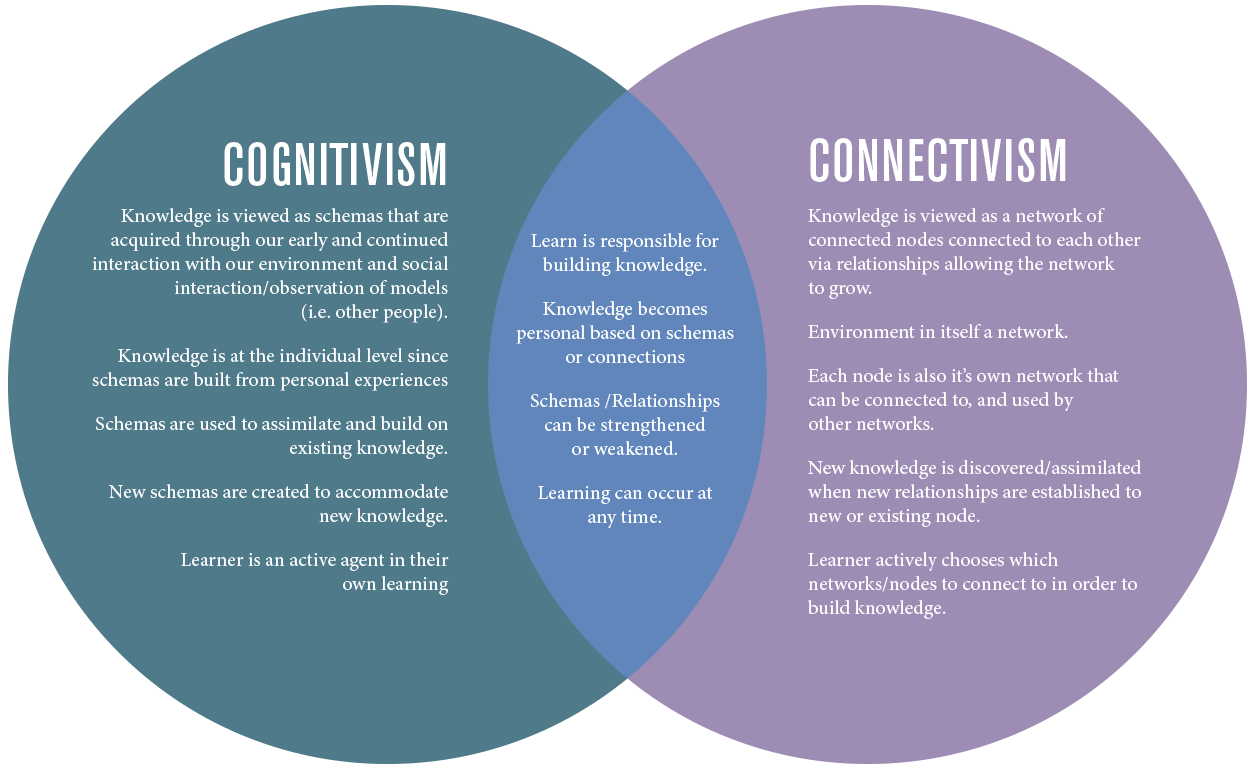
I came across an article where a competitive tennis player wanted to transition to competitive table tennis and felt this would be a great example for both learning theory.
Scenario:
A learner wants to learn how to play table tennis. They have had previous experience playing tennis (Ben Larcombe 2015). Additionally the learner indicates his personal desire to learn the sport at a competitive level, demonstrating the self-efficacy necessary to succeed with both theories (Bandura 1977).
Cognitivism in Practice
With cognitivism the learner would utilize their already established schema (Mergel, B., 1998) and begin to assimilate the similarities between the two sports into the existing schema. However they would need to accommodate different swings, equipment and rules into new schema. This would require the learner to seek out an environment and models (McLeod, 2016) with which they could observe/participate in table tennis, thus building their new schema for the sport, assimilating what can be assimilated and accommodating what cannot.
Connectivism in Practice
Establishing connections and relationships is at the core of the connectivism principle of a network (AlDadouh, A. A., Osório, A. J., & Portugal, S. C. 2015). In the article the learner “struck a deal with the man in charge of the club: I would give him tennis lessons in exchange for table tennis lessons.” Both men created nodes in their networks and the owner of the club could now act as a guide to other nodes for the learner and vise versa (as each becomes a specialized node to the other). From here it could be suggested to the learner what instructional videos to watch on YouTube, what professionals to take note of and learn more from. The article mentions that the learner “was constantly asking others how I could get better”. This again expands their network to new nodes.
Personal experience with cognitivism and connectivism
My own experience with both of these theories has been with increasing my skill set and knowledge of software and techniques. One area has been color correction in Adobe Premier. The course I took was on the SkillShare platform and was a series of video lessons, broken out into chunks. It required the use of established schema for the software I was using. Then the new information was assimilated into that schema. So it was a mix of cognitivism and cognitive load theory.
At the same time, the way I found the course was via connectivism. I started search for information and best practices, tutorials and articles, software presets, and so forth. As I build my network on the subject I was interested in I came across a youtube channel that was focused on all things motion graphics and editing. The owners of that channel were the ones that created the SkillShare course. So that youtube node led to the skillshare node. I now reference that youtube channel for more advanced techniques, thus strengthening the relationship to that node.
Another interesting factor was that during the time that the skillshare course was made, the software was also updated. This caused a change in some the already recorded instruction. The course addressed this by including an addendum lesson, something that can happen often when software is involved in a connectivism model.
Diagram and Scenario references.
Anthony William (Tony) Bates. Teaching in a Digital Age, Retrieved May 25 2020
https://opentextbc.ca/teachinginadigitalage/chapter/3-3-cognitivism/
David L, “Cognitivism,” in Learning Theories, June 19, 2015, Retrieved May 25 2020
https://www.learning-theories.com/cognitivism.html
krist2366, “Connectivism (Siemens, Downes),” in Learning Theories, June 1, 2015, Retrieved May 25 2020
https://www.learning-theories.com/connectivism-siemens-downes.html.
Siemens, George. Jan, 2005. Connectivism: A Learning Theory for the Digital Age. Retrieved May 25 2020
http://er.dut.ac.za/bitstream/handle/123456789/69/siemens_2005_connectivism_a_learning_theory_for_the_digital_age.pdf?sequence=1&isallowed=y
AlDadouh, A. A., Osório, A. J., & Portugal, S. C. (2015). Understanding knowledge network, learning and connectivism. International Journal of Instructional Technology and Distance Learning,12(10), 3-21. Retrieved May 25, 2020, from https://files.eric.ed.gov/fulltext/ED572896.pdf
Ben Larcombe April 23, 2015, Bryan Song: Talent Transfer From Tennis to Table Tennis. Retrieved May 25 2020
https://www.experttabletennis.com/bryan-song/
McLeod, S. A. (2016, Febuary 05). Bandura – social learning theory. Simply Psychology. Retrieved May 25 2020
https://www.simplypsychology.org/bandura.html
Bandura 1977 Self-efficacy: Toward a Unifying Theory of Behavioral Change. Psychological Review 1977, Vol. 84, No 2, 191-215 Retrieved May 25 2020
https://d37djvu3ytnwxt.cloudfront.net/assets/courseware/v1/05624ff228a31c02f3d52d336b3c872e/asset-v1:USMx+LDT100x+2T2017_2+type@asset+block/Bandura1977PR.pdf
Mergel, B., (1998), The Basics of Cognitivism Retrieved May 25 2020
http://web2.utc.edu/~tjd169/basics_of_cognitivism.htm