Microlearning is a popular approach to learning a specific topic or task. It has seen major growth with the rise of platforms such as Skillshare, LinkdIn Learning/Lynda.com, Degreed, Udamy and more (the list is always growing). Most often delivered in an on-demand, online, and informal setting, focusing on a specific skill, process, or topic. It often utilizes video as a means to deliver learning but traditional web elements are also successful.
Micro Learning Project
MuseScore 2.0 microlearning.
Musescore: https://musescore.com
Musescore is a freeware music notation and tablature program. It is also a thriving community of contributors and musicians. The community is active and continues to grow the knowledge and feature of the software.
Learning theories employed:
It goes with out saying, that as an adult, the desire to learn this software resulted from a change in situation. Knowles indicated this as key principle in andragogy (L Blondy, 2007). As I continued to progress in learning to play the banjo, with a mix of formal and informal learning, I needed a way to have a growing repertoire of tablature readily available, carrying around several physical books was not ideal.
In my formal, instructor lead, learning it was suggested to me to look into Musescore This would also constitute a connectivism approach, my banjo instructor being the special node that created the first connection in my knowledge network (AlDadouh, A. A., Osório, A. J., & Portugal, S. C. (2015).
Setting up the software was easy. Each step in the installation process was chunked out, allowing me focus on one thing at a time. While this type of onboarding processed was mainly for the sake of user experience, it still utilizes the principles of cognitive load theory (Kathryn Whitenton 2013).
Using the software is where the project-based learning comes in. I needed to transcribe printed tablature into a digital format creating the real world situation necessary for my own authentic assessment. To this end I needed to construct my knowledge of the software by using the online community’s knowledge base. The collaborative and online nature of the community would suggest a mix of social constructivism (GSI Berkley 2020) as well as connectivism since the community provides links to other resources (articles/manuals/videos).
Since the end result of the project was always going to “determine whether and to what degree students have learned the material they have been taught” (The Glossary of Education Reform 2013), I personally classify this as a summative assessment. I was either successful or I failed.
The Ah-ha moment
It was not the software itself that created the ah-ha moment. Rather it was how it allowed me to always have tablature on hand. Thanks to the internet of things (Morgan 2014) once I uploaded the tablature I created into iCloud, I was able to access on any device. At home I could view them on my laptop or tablet, at lessons I could use my phone. This created every opportunity to continue learning.
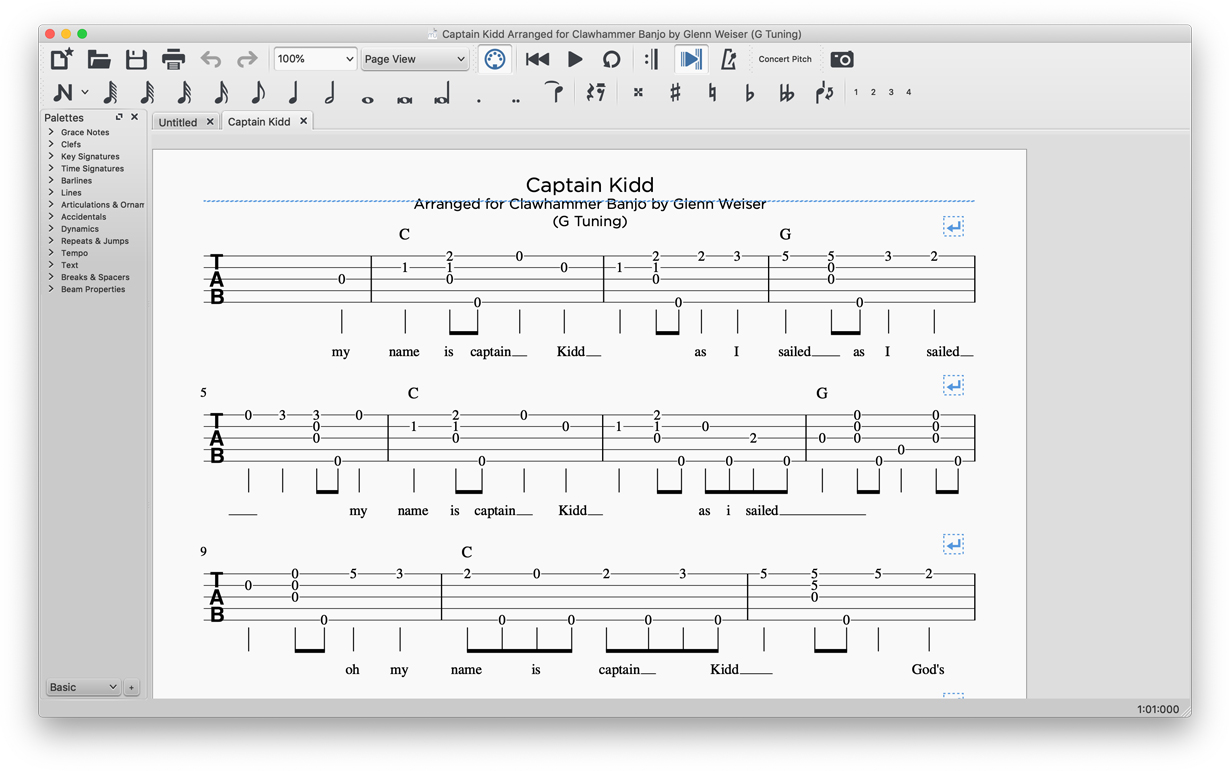
Most recently I needed to add lyrics to tablature so that my daughter and I could do a duet. Musescore has a lyrics feature. To understand how to use it I relied on the already established cognitive schema (Mergel, B., 1998) and the already established knowledge network I was able to implement lyrics in under 30 minutes.
We’re getting better:
References
Laurie C. Blondy, Evaluation and Application of Andragogical Assumptions to the Adult Online Learning Environment, Journal of Interactive Online Learning, Volume 6, Number 2, Summer 2007.
https://www.ncolr.org/jiol/issues/pdf/6.2.3.pdf
Retrieved June 13, 2020
Kathryn Whitenton, December 22, 2013 Minimize Cognitive Load to Maximize Usability
https://www.nngroup.com/articles/minimize-cognitive-load/
Retrieved June 13, 2020
AlDadouh, A. A., Osório, A. J., & Portugal, S. C. (2015). Understanding knowledge network, learning and connectivism. International Journal of Instructional Technology and Distance Learning,12(10), 3-21. Retrieved June 13, 2020, from https://files.eric.ed.gov/fulltext/ED572896.pdf
Vincent R. Genareo PhD and Renee Lyons November 30, 2015 Problem-Based Learning: Six Steps to Design, Implement, and Assess
https://www.facultyfocus.com/articles/course-design-ideas/problem-based-learning-six-steps-to-design-implement-and-assess/
Retrieved June 13, 2020
The Glossary of Education Reform, August 29 2013 SUMMATIVE ASSESSMENT
https://www.edglossary.org/summative-assessment/
Retrieved June 13, 2020
GSI Berkley, 2020 Social Constructivism
https://gsi.berkeley.edu/gsi-guide-contents/learning-theory-research/social-constructivism/
Retrieved June 13, 2020
Jacob Morgan, May 13, 2014 A Simple Explanation Of ‘The Internet Of Things’https://www.forbes.com/sites/jacobmorgan/2014/05/13/simple-explanation-internet-things-that-anyone-can-understand/#51cc466c1d09
Retrieved June 13, 2020
Mergel, B., (1998), The Basics of Cognitivism
http://web2.utc.edu/~tjd169/basics_of_cognitivism.htm
Retrieved June 13, 2020